
Home / Insights / Thought Leadership
Blending Higher Education and Advanced Manufacturing
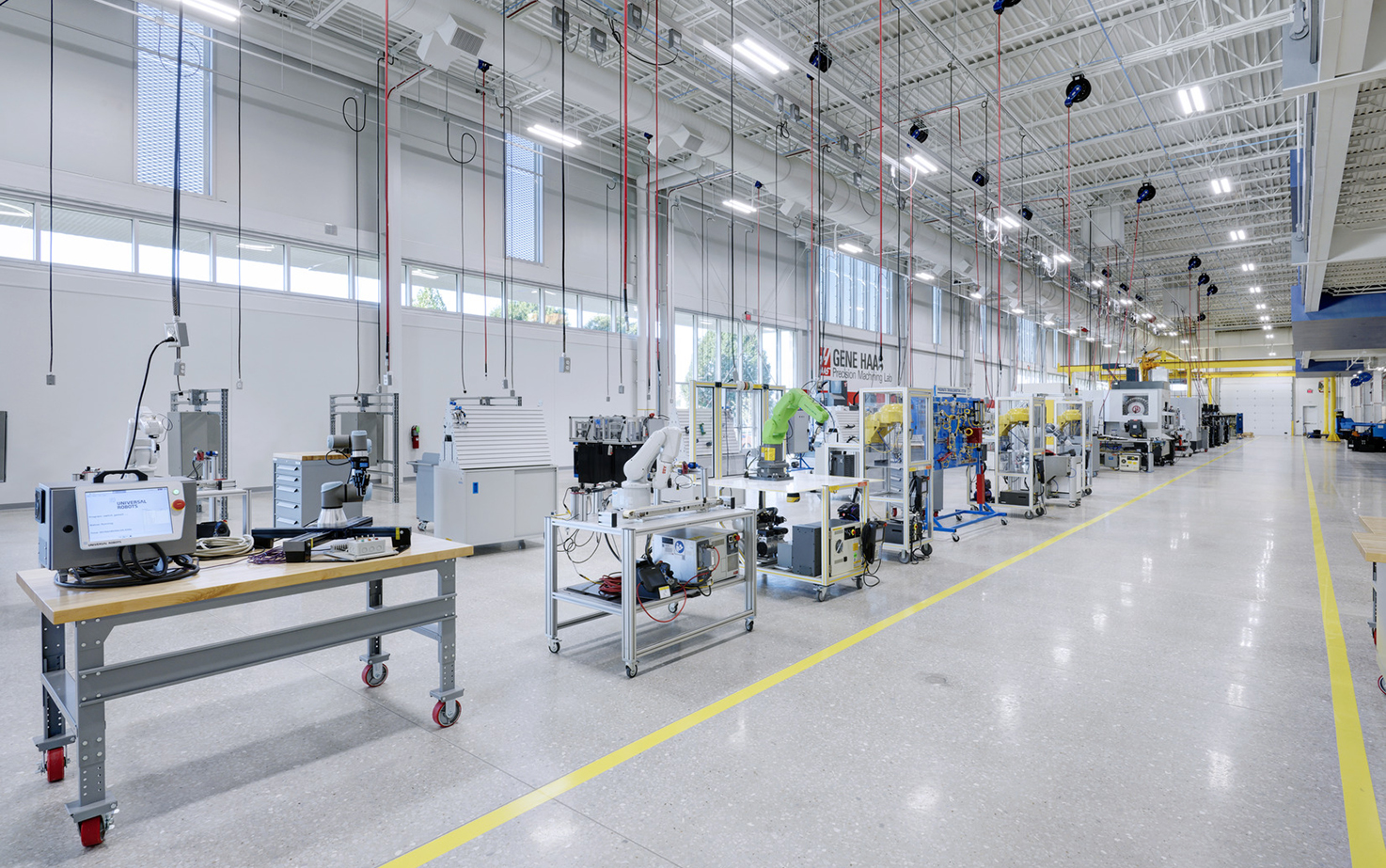
Look up. You probably see some ceiling tiles and a few overhead lights if you’re reading from your desk. For the students, visitors, and industrial partners at the Robert W. Plaster Center for Advanced Manufacturing (Plaster) at Ozarks Technical Community College, they see a facility at work.
With exposed heating, ventilation, and air conditioning (HVAC), color coded hot water and chilled water piping, and other infrastructure elements, instructors can use these systems in technical curriculum to show students how they work in a realized building. But Plaster is not just a higher education facility. It’s a unique blend of a fully operational manufacturing plant, a tour-worth facility, and an educational hub.
Henderson Engineers’ mechanical, plumbing, and fire and life safety systems keep this multi-purpose facility operational and safe. Plaster wants to change how people think about advanced manufacturing, which was emphasized early in the design process. The facility is air conditioned, clean, and features extensive amounts of natural daylight. This project has been recognized for its excellence, receiving the Education Facility Design Award from the American Institute of Architects (AIA).

Overcoming Design Challenges
A blended higher education and industrial facility is not like the true working environment where demands from equipment are spread out. Here, all the students are using the exact same equipment at the exact same time, creating more demanding needs. Compressed air is an example. Sizing compressed air in a facility can be a tricky thing because you have different demands in different locations and at different times. Plaster ended up with more noise and heat from the air compressors than initially anticipated. It became clear that this would be a further challenge once industry partners began using the space as well. We worked with our acoustical engineers and designed a duct solution that solved both heat rejection and acoustical concerns without disrupting architectural constraints. We reduced the amount of noise in the shop space, while still prioritizing a clean appeal for visitors. “They were quick to act, solved the problem, and implemented a great solution for us,” Robert Randolph, Plaster executive director said.HVAC for Occupant Comfort
Today’s advanced manufacturing spaces are expected to be a clean, comfortable, and reliable setting for both people and equipment. Advanced manufacturing spaces often include processes or materials that require a controlled environment so that variables are reduced and outcomes are predictable. In Plaster, this was especially true in the materials testing areas where we provided dedicated cooling and reheat to give inherent temperature and humidity control in the HVAC system selection.
Fire Protection in Advanced Manufacturing
Machine shops and fabrication facilities require a higher level of sprinkler protection than typical classrooms. The high bay area was evaluated, including ceiling height, to ensure the sprinklers are effective in controlling a fire and limiting its spread to protect the rest of the building. There are also some areas that are exposed to freezing conditions. A dry pipe type of sprinkler system was provided for those areas to prevent sprinkler pipes from freezing. A few of the challenges we had to work through included welding gas storage and a dust collection system. These systems are not common in educational facilities. The welding gas is highly flammable, so the storage room required the highest level of sprinkler protection in the building. The dust collection system required sprinkler protection because excessive fine dust can become explosive.Powering the Facilities that Power Industry
Henderson helps advanced manufacturing, industrial facilities, and automated warehouses reduce risk, drive operational efficiency, and create consistency at scale. We approach design holistically, thinking about each facility’s unique needs and how we can help reach operational, energy efficiency, and decarbonization goals while prioritizing speed-to-market. We’re helping grow American manufacturing through reliable design across production and delivering world-class educational facilities to train the future workforce.