
Home / Insights / Thought Leadership
Sustainable Refrigeration Industry Insights: Summer 2023
As we reach the midpoint of a sweltering summer, maintaining refrigerated environments is more crucial than ever. It takes an entire industry of stakeholders to ensure the cold chain is reliable, but reliability is only part of the equation. Sustainability is now a driving force throughout all facets of the refrigeration industry. Our refrigeration experts are actively involved in the effort to move towards our MEP 2040 commitments and refrigerants have one of the largest impacts in achieving that goal. We work with people throughout the industry who are passionate about making positive changes and reducing the impact of the cold chain along the way.
The Refrigeration industry has been notoriously cautious and slow to adopt innovative technologies, but this decade is primed to experience more growth than the past three decades combined. The evolving landscape of natural refrigeration technologies coupled with progressive policy adoption and climate commitments from the largest grocery retailers will lead to exponential change.
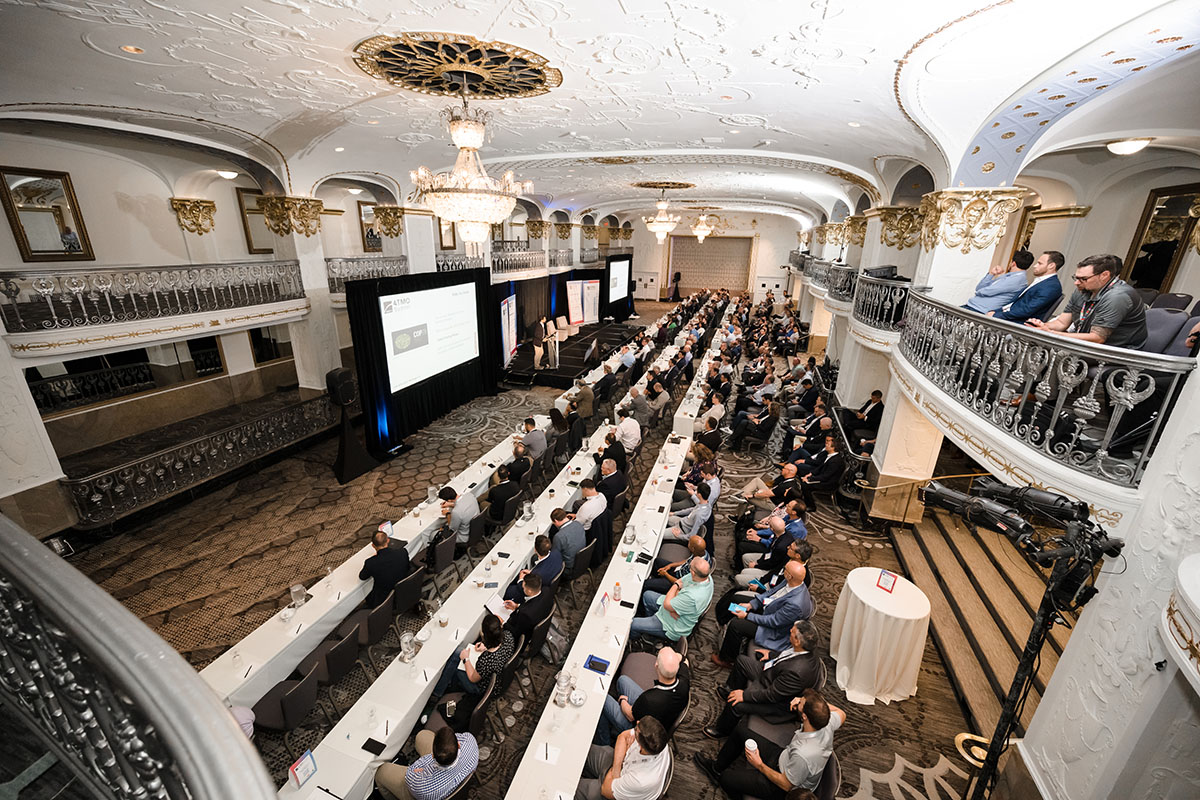
Henderson Engineers recently attended the 2023 ATMOsphere America Summit in Washington, D.C. The annual event provides attendees with insight into the future of natural refrigerant-based technologies, allows for cross functional knowledge sharing among industry peers, and offers presentations ranging from end user sustainable system installation examples to regulatory updates and non-profit involvement. Refrigeration technical managers Jason Cornett, Conner Meadows, and Lidia Leon Perez along with Dustin Padget, practice manager, returned from the event with the following key takeaways:
Regulatory 101
The refrigeration industry is seeing significant regulatory changes with a strong focus on lowering the environmental impact of systems, increasing the energy efficiency of systems, and adopting alternative refrigerants. Regulations are a hot topic within the refrigeration industry and with no doubt will continue to be. The EPA (Environmental Protection Agency) operates the Significant New Alternatives Policy (SNAP) Program to minimize the impact of refrigerants on the environment. This is done partly by reducing the use of high Global Warming Potential (GWP) refrigerants. Some recent and notable regulatory trends include:
- Federal:
- 2021: The AIM (American Innovation and Manufacturing) Act, which was included in the Consolidated Appropriations Act, directs EPA to phase down production and consumption of Hydrofluorocarbons (HFCs) in the United States by 85% by 2036.
- October 7, 2023: EPA Deadline for finalized regulation language regarding HFC refrigerant GWP restrictions.
- October 2024: Earliest time federal regulations around GWP could be enforced.
- 2025: The EPA is proposing restrictions on the use of certain higher-GWP HFCs with GWP limit 150 & 300 for commercial refrigeration systems with 200LBS likely to be the dividing line.
- California:
- 2018: EPA SNAP 20, 21 adopted.
- 2020: 150-GWP new refrigeration cap effective Jan 1, 2022; average GWP (20 or more stores) below 1,400 by 2026 or reduce GWP potential by 55% by 2030.
- 2022: By 2025 you must have a plan to transition from HFCs to ultra-low or no-GWP no later than 2035.
- New York
- 2021: EPA SNAP 20, 21 adopted.
- 2023: Propose the use of 20-year GWP, rulemaking for new GWP < 10, bans and refrigerant reporting system.
- Washington
- 2020: EPA SNAP 20, 21 adopted.
- 2023: Rulemaking for new GWP caps and refrigerant management system.
- Maine
- 2021: PFAS regulation enacted using OECD definition; requires reporting of PFAS (Per- and polyfluoroalkyl substances) refrigerants, with possible bans in 2030.
- Transcritical CO2 scroll compressors
- Two-stage compression for low temperature applications
- Mechanical expansion valves
- Proprietary high ambient controls strategies
- Mechanical sub-cooling
- Adiabatic cooling
- Parallel compression
- Ejectors + parallel compression
- High pressure ejectors
- Low pressure ejectors
- Pressure exchanger
- Flooded evaporators
- Predictive maintenance suites “informed by ai and machine learning”
- Proactive adaptation.
- Don’t just meet the minimum requirements; actively seek new ways to adopt environmentally friendly refrigeration solutions.
- Build partnerships.
- Work with international counterparts, such as European manufacturers, to share knowledge and implement proven practices.
- Focus on research and development.
- Dedicate time and financial resources to developing innovative solutions tailored to specific needs.
- Engage with end users.
- Regularly collect and analyze feedback from users to continuously improve product offerings.
- Stay informed.
- Regularly analyze industry data and trends to keep regulations up to date and effective.
- Incentivize sustainable practices.
- Create financial incentives or recognition programs for businesses that effectively implement sustainable refrigeration technologies.
- Create practical regulations that are effective in protecting the environment while being economically feasible for businesses to implement.
- Prioritize environmental responsibility.
- Make environmental protection a core value and objective across all operations and practices.
- Utilize international knowledge.
- Actively seek and incorporate international expertise in refrigeration, adapting it to local needs and standards.
- Engage with the public.
- Make community engagement a priority and be transparent in communication and decision-making processes.